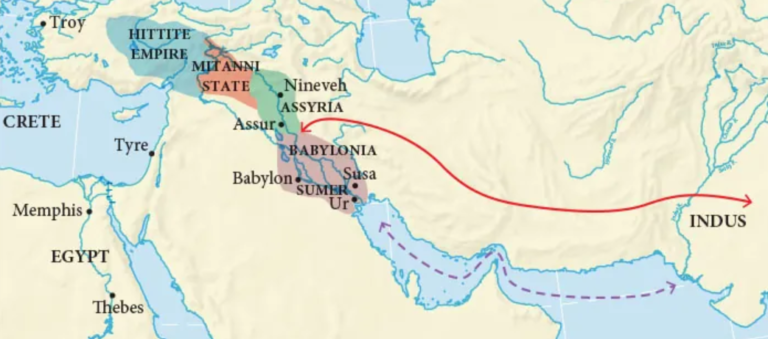
Medo-Parthian nexus of Avesto-Vedic-Sramana (AVS) Religions
Brahminism, Buddhism, Jainism and Zoroastrianism have common roots and share stories with similar themes. These religions of the east have remarkable linguistic and philosophical parallels and shared structures that indicates a historically common meeting point. We can observe a noticeable influence of Achaemenid and later Parthian empires (5th century BC to 2nd century AD) on their source martials. Therefore, these eastern religions can be grouped together as Avesto-Vedic-Sramana (AVS) Religions for convince.
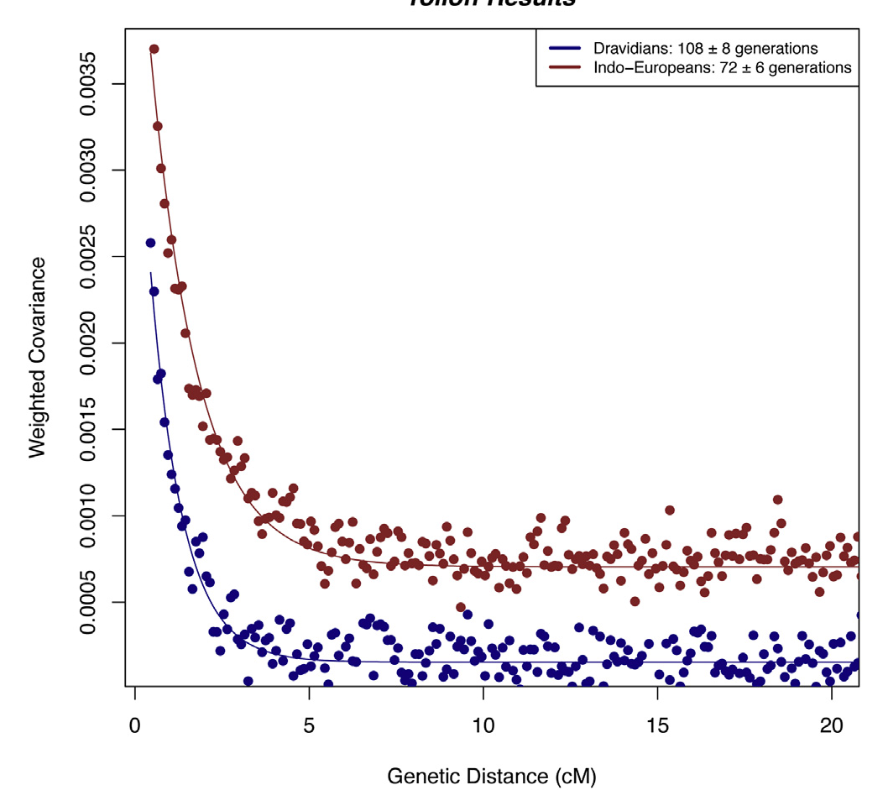
Archeologically Indian history begins with Harrapan Civilization from 2nd Millenium but by around 1500 BC, those cities were deserted and people dispersed. For next thousand years there is no sign of any urban settlements or large cities in the subcontinent until the arrival of Aryans. Around 500 BC, new groups arrive in India starting second urbanization period. The population distribution of India also confirms the distinctness of the groups in genetic studies. Consider the Population admixture of Ancestral North India (ANI) and Ancestral South India (ASI) which show a gap of 30 to 50 generations between each other.
Achaemenian Architecture in Mauryan Empire
Ashokan period is the next major historical event identifiable archaeologically in ancient India after Indus valley. Ashoka the Great (reigned 268–232 BCE) governed a vast empire that covered much of the northern Indian subcontinent. He instituted Inscriptions all across India written in the Brahmi script (also known as Dhamma Lipi) which is the earliest deciphered script of India. Ashoka, the third ruler of the Mauryan Empire, embraced Buddhism and played a pivotal role in its propagation from Greece to SriLankan. All the current scripts in south & east Asia are the developments derived from Brahmi script with regional variations to meet local sounds.
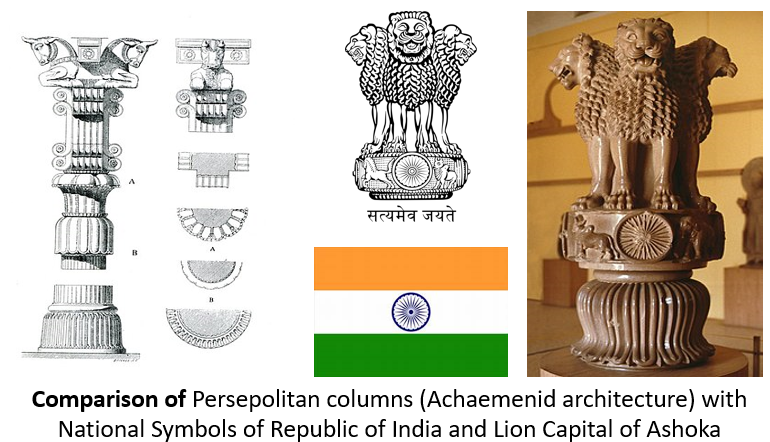
Ashokan legacy continues to influence even in modern times. Symbols from this time are part of the India national emblem, currency or key iconography. Below are some examples adopted by government of India:
- The blue circle in Indian Flag is the wheel of dharma used by Ashoka
- National Emblem of four faced lion is used as national seal and on Indian Currency
- Lotus is the National flower
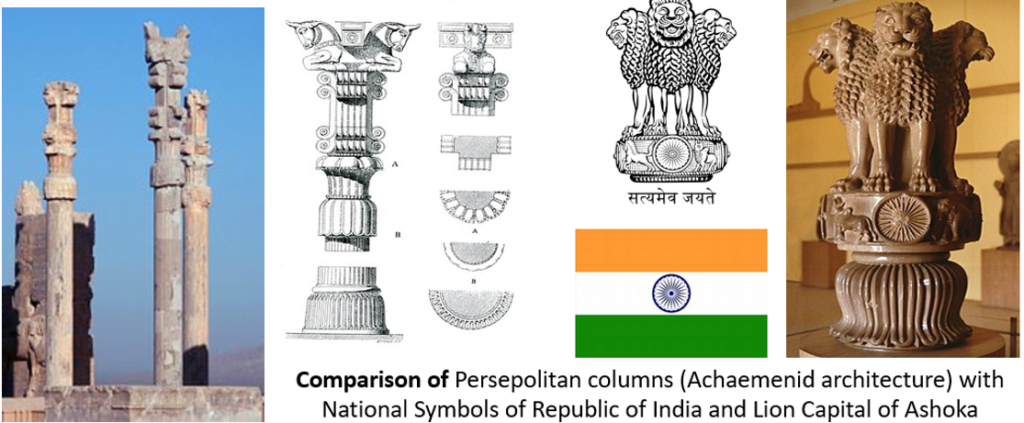
When we consider the architecture of Lion Capital of Ashoka and similar structures from Sanchi and Mathura, they all resemble pillars in Persepolis and Susa build around from 4th c BC. The Lion face, the lotus petals and smooth polish are an indication that the artisans with Achaemenid influence were employed by the Mauryans. As Alexander was invading the region, it is possible many skilled workers moved eastwards into the subcontinent. Taxila emerged as major center of learning were several skills along with the linguistic and military skills were taught. According to Sanskrit epic ‘Brihatkatha’ and the Buddhist scripture ‘Mañjuśrī-mūla-kalpa’, Panini was contemporary of king Dhana Nanda (329-321 BC). He was from Gandhara and learned at Taxila and wrote grammar for Sanskrit. Also, buddha’s personal physician Jivaka was trained in medicine at Taxila.
Epigraphy evidence vs Literary Sources
The greatest dilemma for Indian Historians is the miss match between the Literary sources (like vadas, puranas, jatakas etc.) and the Archeological findings. Unlike Greek and Chinese sources, Indian textual sources do not corelated with the archeological findings. Most of our understanding of Indian history comes from the Epigraphic and Numismatic evidence from 3rd c. BC onwards. Anything before that period is deduced from textual sources which are subjective, highly localized and religiously biased giving very little scope for critical analysis.
Comparing the writings of Greek, Buddhist and Arab travelers like Megasthenes, Fa-Hien, Hiuen Tsang, Al-Beruni or Marco Polo; Indian literary works especially those promoted by Brahminism are out of touch with geological landscape of the times or else our understanding is blurred due to the religious bias. Religion is a major hurdle for truthful interpretation of the texts and because of this religious overtone the critical analysis of texts has been suppressed for over a century. In recent times the accessibility of ancient texts and the archeological discovers increased with internet lifting the dark mist of bias, and now people are uncovering the broken links between east and the west.
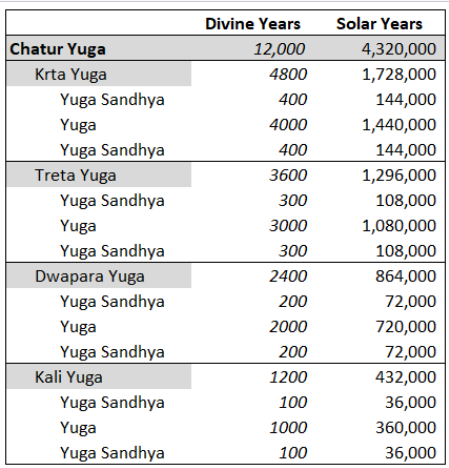
For example, consider the yuga cycle where the chronology of the ages spans millions of years just like the hypothetical geologic column with preposterous timelines. Theses hypothetical cycles were also found in Babylonian astronomy for example 432 cycle. Compared to Brahminical texts Buddhist and Jain texts are more reliable as they mention contemporary kings and regions which are in sync with archeological discoveries. Also, the use of words like Asura, Ila and Yama and the HariRud River in the Vedic texts point to the clear eastward migration of Aryans carrying those philosophical ideas into the subcontinent.
Medo-Persian ‘Aryan’ influence
The word Aryan is used across AVS religions texts in positive terms. Archeologically the word Aryan first appears in Inscriptions setup by king Darius of Achaemenid empire. The Aryan influence into India started in 5th century BC when Darius conquered Indus. According to Herodotus Darius sent the Greek explorer Scylax of Caryanda to sail down the Indus River, before occupying the region around 520 BC. There are also Indicators like Achaemenian coins found in Indus Region like in Kabul horde or Bhir Mound, and inscriptions in Aramaic at Takshashila (Taxila). Achaemenian revenue records also reflect that the Indus region is the highest contributor of revenue equaling around 32% in the kingdom. And later Ashoka’s use of Aramaic in his edicts solidifies the influence of Medo-Persian and links the arrival of Aryans into the Indian Subcontinent.
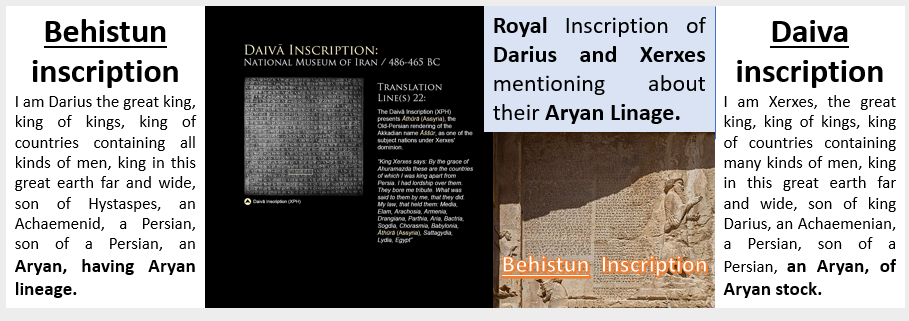
Darius in Behistun Inscription mentions that he belongs to Aryan Linage. The word Aryan was used by Achaemenian and Parthian kings to claim noble or royal linage. Considering the length of reign and the expanse of their domain, the word Aryan would have been taken in high regard for over 800 years (from 600 BC to 200 AD). So, obviously any writings from that period will use the word in that context. There are many such words in use for example:
- the use of title like king of kings (rendered Xšāyaθiya Xšāyaθiyānām in Old Persian), Rājādhirāja and šāhān šāh is used by different kings in India
- greek word satraps (is old Iranian khshathra-pa written as khshathapavan (𐎧𐏁𐏂𐎱𐎠𐎺𐎠, literally “protector of the province”) and their decadents are known as kshatriyas)
- Dahayau means land or country in Old Persian, which became Desh meaning country
Many times, we see oral traditions are codified to preserve knowledge under royal decrees and patronage by later kings just like Assurbanipal’s Library in Nineveh or Ptolemy library at Alaxandria. So, the word Aryan has direct correlation with Iran and all the AVS Religions associate themselves with the term as most of these texts were codified in that period. That’s why just relying on textual sources will give very little information about the time of writing.
Buddhist names in Persepolis seals
Appearance of Mahajanapadas and the rise of second urbanization in India has direct correlation with the expansion and collapse of Medo Persian empire. This convergence can be observed in art and architecture, in religion and sciences, in trade and culture. Furthermore, the Y lineages of Indian castes are more closely related to eastern Europe than to Indian tribal populations, suggesting that Indian caste groups are primarily the descendants of Indo-European language group.
Darius mentions killing an imposter called Gaumata but the other histories described him as an astrologer and a compassionate philosopher who decreed freedom for slaves, lowered oppressive taxes across the board in Babylon, and inspired neighbors to respect one another in a city known for its diverse ethnic groups and many languages. Babylon (Esagila) was a place for higher learning, and these Royal scholars had significant influence in the governance at that time.
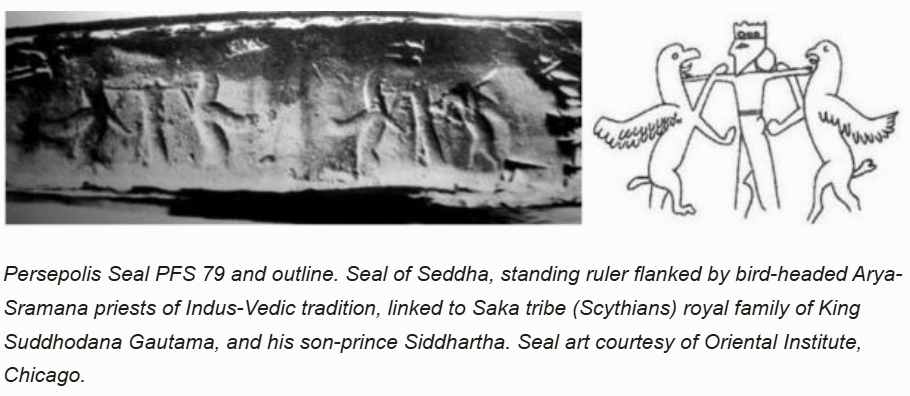
Babylonian Gaumata (Gau=cow & mata=mother) mentioned on Behistun Inscription and the mention of deva worshipers in Daiva Inscription are some of the strange references to Indian names. Persepolis Seals (PFS) mention names like Sada (PF 149, PF 1224), Sudda (PF 372 and PFS32), Tissa (PF 781 and PF 1124), Saka (PF 1970), Saksaka (PF 1511) etc. These are the personal seals of Nobels in authority that are used for administrative prepose written in Elamite and Aramaic language. Another name of Gautham Buddha is Sidhartha who is also known as Shakyamuni (or sage of sakas). All these references point to Saka tribes (especially Sakā haumavargā) who were slowly migrating into the subcontinent.
Scribes, Libraries and codification into Religion
In general observation, the origin of religion is always tied to the fall of a Kingdom because every religion at its roots can be traced to the culture of a kingdom and its laws. Every human (with spirit, soul and body) or a family (with father, mother and children) can also be considered as smallest kingdom. So, when the kingdom disintegrates the people with specialist skills regroup and organize into smaller groups. These units in order to preserve the useful knowledge which are no longer are applicable at that sophistication are passed down as traditions and cultures. Over a period of time these laws lose their original intent becoming rigid societies which we call as Religion.
In the ancient world, scribes formed the backbone of a kingdom’s administrative machinery. The greater the empire, the more extensive were their libraries. A striking example is the library of Assurbanipal, who recognized the strategic value of knowledge and devoted immense effort to gathering texts. His ambitions, however, met resistance from Babylon which was the greatest center of learning in the ancient world. While Elam and Egypt were also notable hubs of scholarship, none rivaled Babylon, heir to the intellectual legacy of ancient Uruk.
After the decline of the Assyrians and Babylonians, the Achaemenid Empire introduced new instruments of learning, most notably the Aramaic script. They promoted Old-Persian along with the Aramaic script across the vast empire even from Egypt to India. Its spread helped popularize the Phoenician-derived writing system throughout much of the known world. This cultural push may have played a role in the establishment of schools at Thakshila in the Indus region, which came under Darius’s control around 516 BC.
Date of Compilation of Vedas from Zoroastrian sources
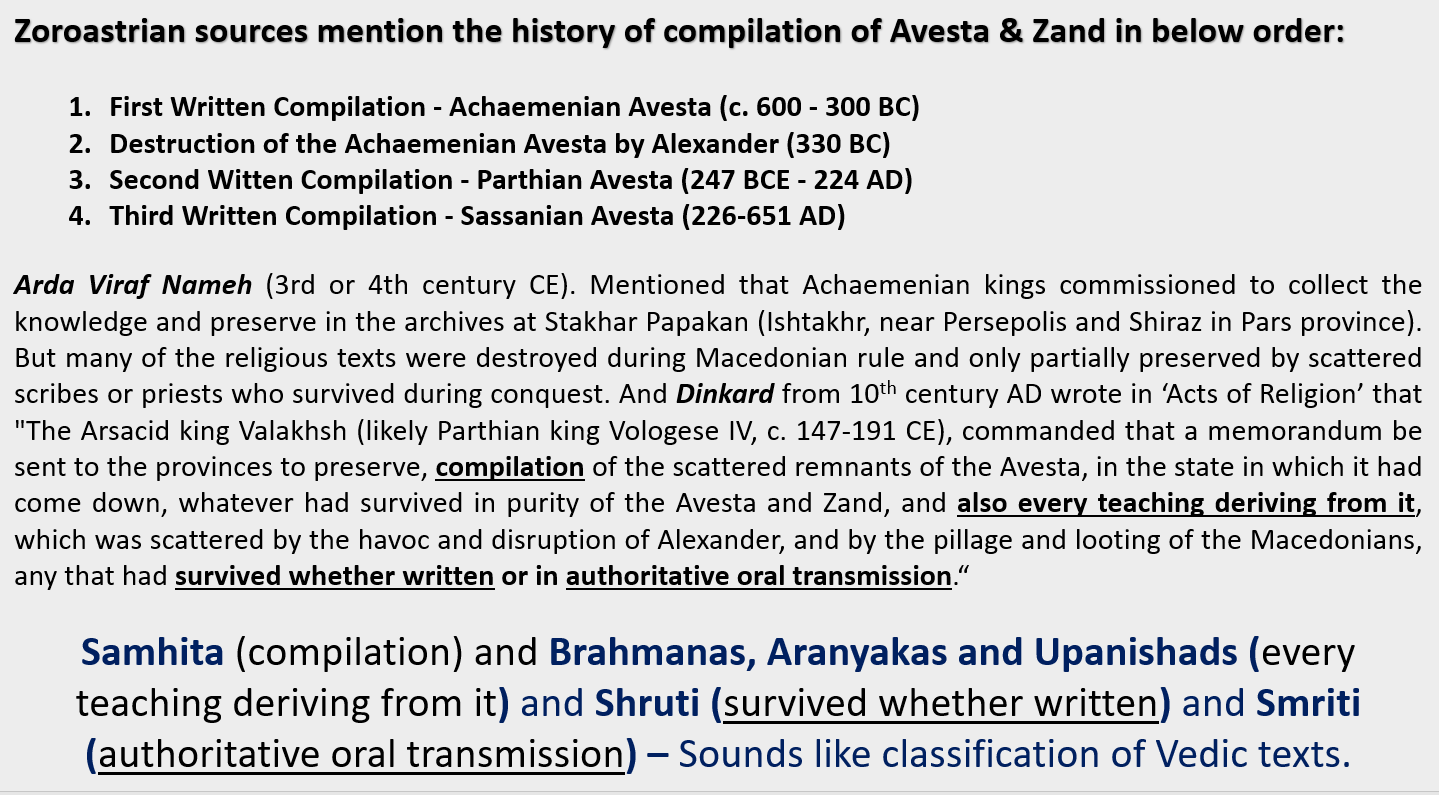
Zoroastrian Gathas are considered to be written in Old Avestan which is similar to Vedic Sanskrit and Old Persian. Zoroastrian sources written by Arda Viraf Nameh mentions that the Achaemenian kings (c. 600 – 300 BCE) commissioned to write sacred texts and deposit the texts in the royal library at Ishtakhr. These works were later destroyed by Alexzander, but Denkard (Zoroastrian encyclopedia) mentions that Parthian Kings ordered to recompile everything that has survived in written or authoritative oral tradition. This Parthian order gives clues why the Indian texts are classified as Smriti and Sruthi. Also, use of word Samhitas (meaning compilation) for initial section of Vedas makes perfect sense in this context.
Rigveda is considered as the oldest collection (Samhita) of writings of 10 Books. Of which the Mandalas 2–7 are known as Family Books which are attributed to 7 Sages (Scribal Houses). The remaining books (1, 8-10) are more composite and diverse in authorship and content. Scholars studying Textual variance have identified at least 17 different stylistic layers or writing styles. That’s why Rigveda and ancient middle-eastern mythologies share significant parallels in themes, structures, and deities.
Sanskrit and Avastan Relationship
Sanskrit and Avestan are classified under Indo-Iranian family language group which related languages along with Old Persian. Linguists classify these languages within the Indo-European family, as they share significant similarities and can be traced to a common origin. The striking parallel in these Languages is the technical words with synonymous or opposite meanings. For instance, Deva in Sanskrit means “god,” whereas its Avestan counterpart Daēva refers to a demon. Many European languages also retain Dev in the sense of “god.” Such contrasts, alongside linguistic affinities, point to a shared heritage for the Avesta and Vedic compilations. Historically, their most plausible point of contact was during the Medo-Parthian period, when India and Iran engaged in deep socio-cultural exchange. This suggests that Sanskrit and Avestan can be seen as parallel renditions of Old-Persian tradition, possibly codified after the 2nd c. AD.
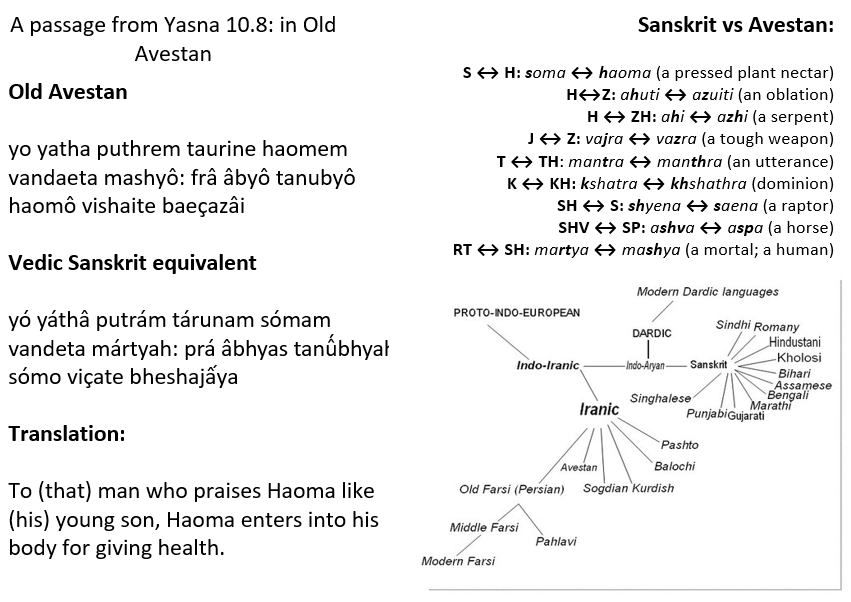
Some of the ancient Brahminism and Zoroastrianism texts are written in these languages which are dated to 2nd Millenium BC purely on linguistic grounds. But the earliest known epigraphic evidence for these languages is found only after 4th c. AD. Some of the well know inscriptions from 2nd century BC are Ayodhya Inscription, Naneghat inscription and Hathibada Ghosundi inscriptions. All these inscriptions are in Brahmi script with many Prakrit words than Sanskrit. Spitzer Manuscript is the oldest known Sanskrit manuscript written in Brahmi script (Kushan style) by Buddhist scholars. Current manuscripts of Sanskrit are all in Sharada and Devanagari script which became popular only after 8th c AD.
Linguistic diffusion over time: Old Persian Dialects
The term Sanskrit means “well-prepared, refined, or polished,” while Prakrit signifies “natural, coarse, or original.” In Magadha, Prakrit functioned as a semi-formal, colloquial language, whereas Sanskrit served as the formal medium for official and scholarly purposes. With the introduction of the Brahmi and Kharosthi scripts, transcription or transliteration of Old Persian texts from the Achaemenid period in the Indus region, fostered the growth of its scribal traditions in India.
Clear phonetics and precise grammar are essential for an official language, ensuring consistent meaning across time and distance. In the Achaemenid Empire, Aramaic particularly Imperial Aramaic served that purpose as the administrative language. Its streamlined set of script signs enabled its rapid adoption by scribes across the vast stretch of empire even from Egypt to India. Many manuscripts and inscriptions confirm that all of them adhere to the linguistic standard of the empire (The Khalili Collection of Aramaic Documents and Elephantine papyri from Egypt).
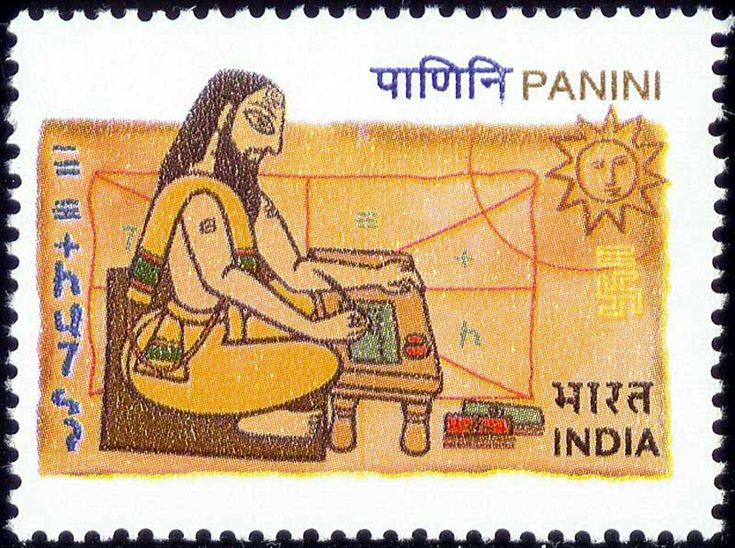
Pāṇini, the renowned Sanskrit grammarian from the Gandhāran region, records that at least ten grammarians preceded him in shaping photonics and phonology for Sanskrit i,e Old Persian. Pāṇini’s Sanskrit sought to preserve the linguistic traditions of Old Persian (Madhyadesha or Median phonetics’), which is the root of Vedic Sanskrit and old Avastan. Such learned communities were responsible for keeping records and correspondence.
Zoroastrian ideals like bahman (good thoughts) reflect a moral-linguistic tradition shared by priestly and administrative classes, similar to Babylonian scribes. As the Greek empire expanded, Aryan cultural and linguistic systems were gradually pushed eastward. In this shifting landscape, Jain and Buddhist traditions were preserved in local dialects like Pāli and Prākrit,
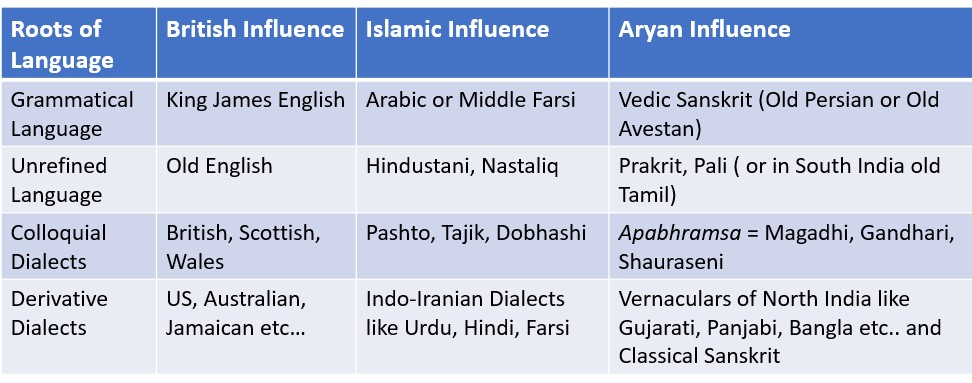
In natural speech, words are often shortened or merged as long as mutual understanding is preserved. Over time, such variations form distinct dialects. But official languages spread quickly among scholars but diffuses slowly through society.
When these dialects interact with others languages, they can give rise to entirely new languages. This process is evident in India’s history when we observe the Influence of Aryans, Islamic and British on local languages. Also, climatic changes like cold or hot or humid, region changes due to wars or natural disasters, environmental factors like local flora and fauna, and cultural factors like festivals and traditions fuel linguistic and phonetic changes. Overtime, such shifts (e.g., p to b, v to b) accumulate, creating distinct languages or dialects.
Limitations of Oral Traditions
Oral traditions, while vital for preserving cultural memory also face several limitations. They rely heavily on human memory, making them vulnerable to distortion, loss, and variation over time. Without written records along with rigorous mnemonic techniques, information can disappear with the passing of its custodians. Narratives often change with each retelling, leading to inconsistencies, and their transmission is typically confined to specific communities. Additionally, oral accounts may reflect personal or cultural biases and are difficult to verify or date accurately.
Oral traditions persist for long period only under certain cases like folklore, stories, proverbs. They typically preserve the gist of teachings rather than exact phonetics. To preserve phonetic variations strong mnemonic techniques with symbolic or writing aid is essential. There should also be strong incentive or need to preserve these traditions for longtime.
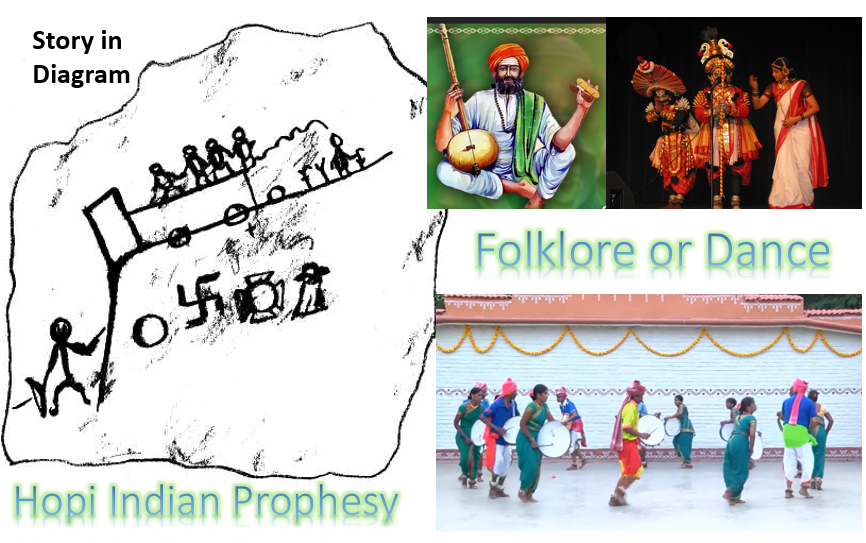
The claim that the Vedic works were transmitted orally for thousands of years becomes questionable given the sheer volume and complexity of the content. These texts include areas like astrology, medicine, ritual customs, stories etc. While such knowledge may have originated in oral traditions, it is unlikely to have survived unchanged over millennia. In oral cultures, only those elements that continue to fulfill a community’s cultural or practical needs tend to be preserved. As societies evolve and interaction with other cultures or environments, language and tradition naturally adapt. So, without formal writing systems or institutional support, such as royal patronage, scribes, or archival practices, languages and their associated knowledge systems tend to diffuse, with grammatical structures and precision often lost. Oral forms are highly adaptive and can shift significantly within a generation, retaining only what remains culturally relevant.
Mitanni, Kikkuli and Khur/Hurrian Roots
The presence of Indo-Aryan elements in the Near East during the second millennium BC is attested in several key sources. The Mitanni kingdom (Ḫanigalbat / Naharin) shows clear traces of Indo-Aryan influence. The Kikkuli horse-training manual, Hittite-Mitanni Treaty between Suppiluliuma and Shattiwaza and the Amarna letters are a rich sources proto-Indo-Aryan words used in Levant in the middle of the 2nd millennium. BC.
One of the Mitanni kings, B(/p)aratarna, bears a name that closely resembles Bharata, know as founder of Bharatvarsha in Indian tradition. Such parallels suggest not only linguistic affinity but possible cultural continuity or common origin.
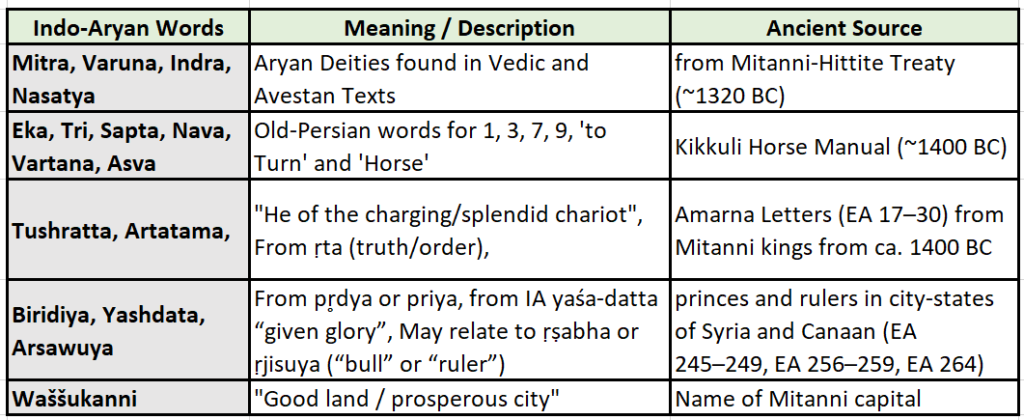
Egyptian records refer to the Hurrians as ‘Khor’/Kur, they are also known as Churri, Horri, Hurri in Ancient near east. These ethnonyms show notable phonetic similarities to the Kuru tribe mentioned later in Indian traditions, suggesting a possible ancestral or linguistic connection. The Biblical scholars suggest Horites as Hurrians. This aligns with the hypothesis of a migration of Indo-Aryan speaking groups from eastern Anatolia, northern Mesopotamia, or Syria toward the Gangetic plains. The Vedic and Avestan textual evidence add further support to this theory.
Middle-East roots of Vedic thought
Several linguistic features of Rigveda Mandala 10 diverge from the so-called “core” Rigvedic language, which is found mainly in Mandalas 2–7, suggesting a later date of composition during a transitional period. Notably, the rivers Ganga and Yamuna are mentioned directly only once in the Rigveda (RV 10.75.5), with indirect references to Ganga (RV 6.45.31) and Yamuna (RV 3.33.6) appearing just once each. By contrast, rivers in the Sindh–Afghan region are cited repeatedly.
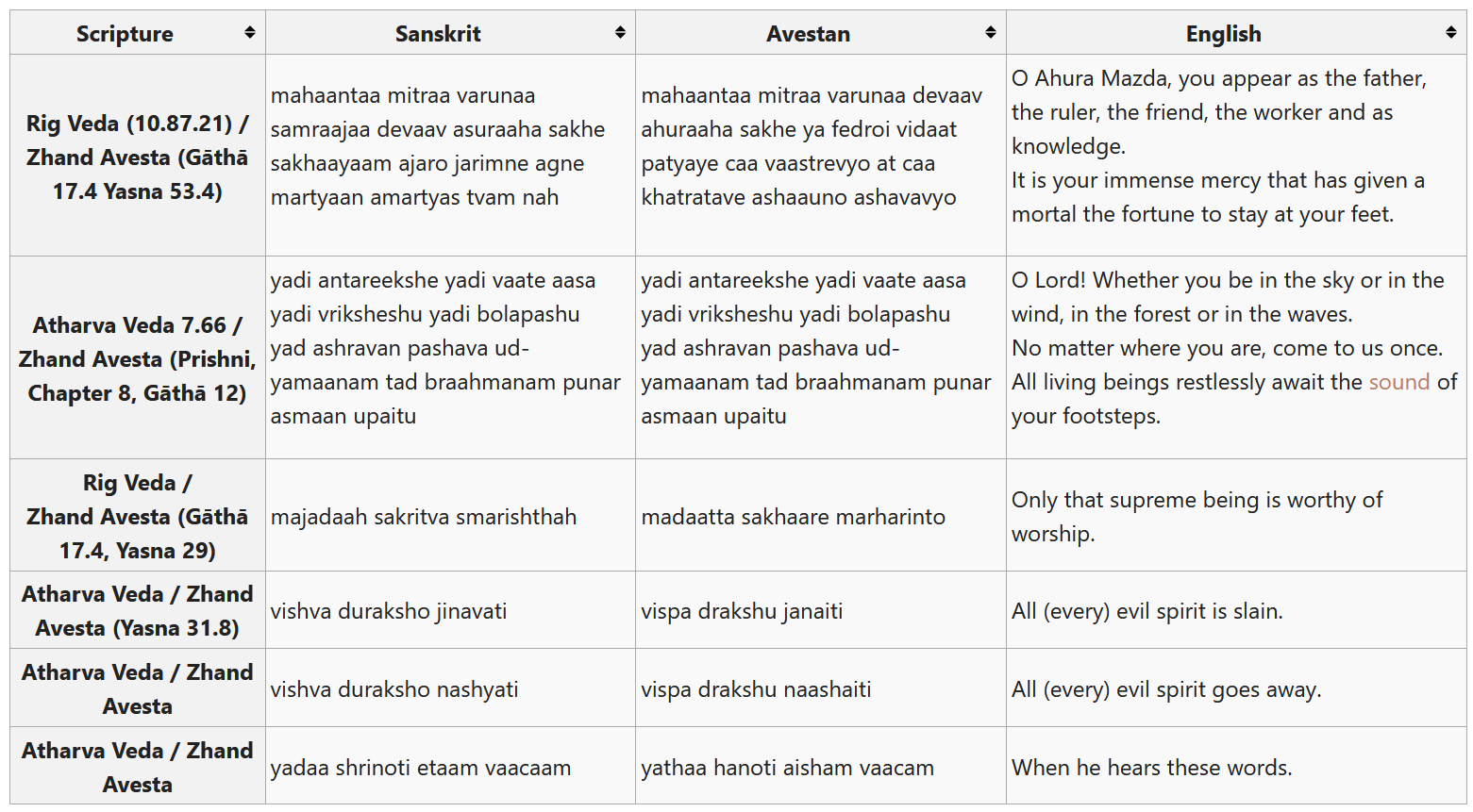
Collectively, the linguistic and geographical evidence, together with the probable time and setting of Vedic composition, point to a clear circulation of Middle Eastern religious concepts within the authors’ milieu. Influences from the Assyrian sphere found their way into both Zoroastrian and Vedic traditions. In certain contexts, the term Asura likely reflects direct awareness of the Assyrians. Notably, in RV 10.87.14 and 21, Áhura Mázdhā is invoked in a distinctly hostile tone, implying a theological or political confrontation between the two traditions, a conflict later mirrored in the Achaemenid “Daiva” inscription.
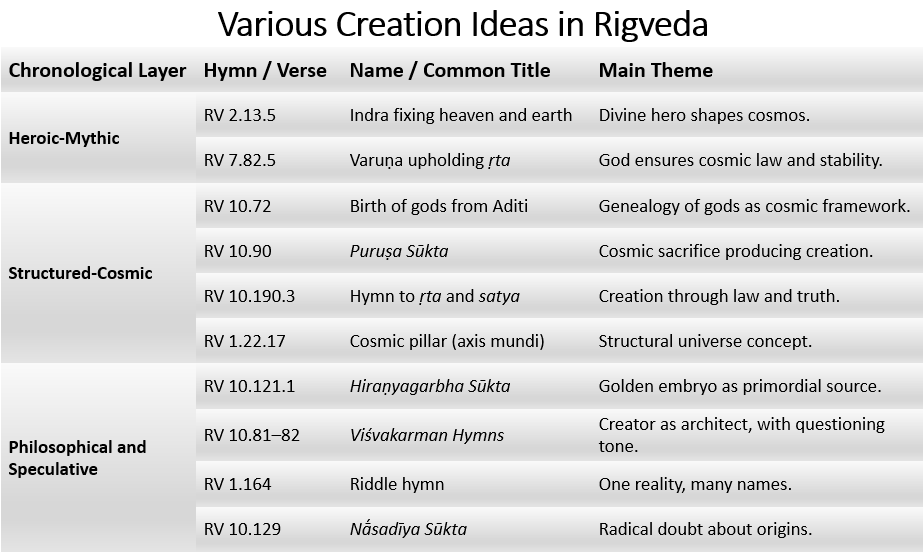
The presence of at least ten distinct creation narratives points to a consolidation of ideas from diverse cultural sources. As we move from the Saṃhitās to the Brāhmaṇas and Āraṇyakas, it becomes evident that Middle Eastern deities were gradually adapted, assimilated and transformed into Indianized forms, reflecting evolving Vedic tradition.
The co-location of Babylonian and Indian satrapies under the Achaemenid Empire brought these regions into a single political framework, creating ideal conditions for the exchange and transmission of knowledge. Monotheism, however, was not yet dominant in Achaemenid times; Ahura Mazda is already listed in Assyrian records, such as the Neo-Assyrian god list (III R 66) from the library of Ashurbanipal, dating to the 7th–8th century BCE. The enduring conflict between the Devas and Asuras, as recorded in the Vedas and Purāṇas which mirrored in the Avestan opposition between Daēvas and Ahuras gains additional depth when viewed against this historical backdrop.
Tracing Hindu Iconography from the West Asia
Even though Vedas strongly oppose idol worship (e.g., Rigveda 8.1.1, 10.81.3; Yajurveda 32.3, 40.8; Atharvaveda 13.4.16) we can notice slow transition towards idols. Several Vedic names and descriptions show striking parallels with deities from other ancient cultures. For example, Apsujit (“conqueror of the waters,” RV 2.12.12) recalls Near Eastern water-conflict motifs; Yama with his two dogs (RV 10.14.10–12) closely mirrors the Mesopotamian god Nergal (Yam meaning “sea” is a chaos-dragon in Phoenician mythology). In later centuries, explicit cross-cultural identifications appear. The progression from Mesopotamian Inanna to Achaemenian Anahita to Indian Durga is also unmistakable continuity of same Image with different names.
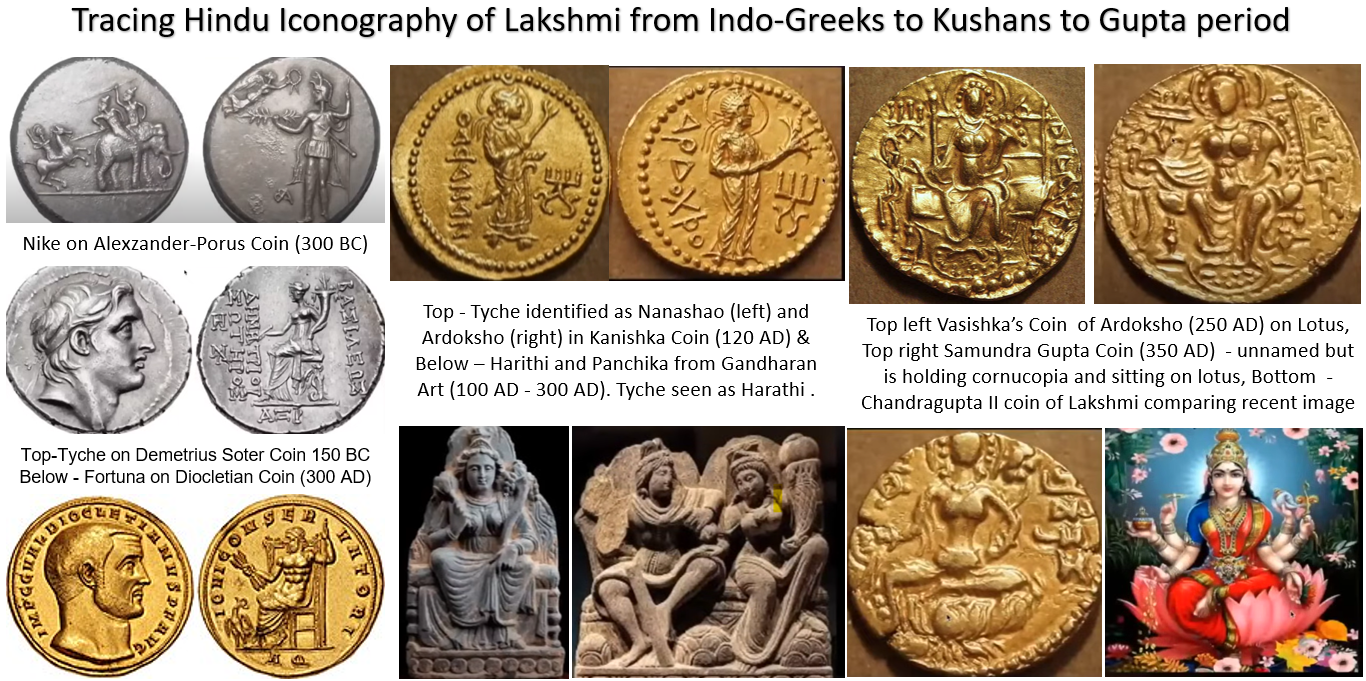
The Indo-Greeks were the first to issue coins bearing images of gods, a practice later adopted by the Indo-Śakas and Kushans. In Indo-Greek, Hercules was consistently identified with the Indian deity Balarāma/Saṃkarṣaṇa which was carried on in later traditions. The Sasanian Naqsh-e Rostam relief bears inscriptions equating Zeus with Ahura Mazda and Zeus resembles Indra the god of thunder.
The Kushan Rabatak inscription of Kanishka marks a turning point in the emergence of anthropomorphic depictions of divine figures morphing Greek and Persian ideas into Vedic gods. It states: “And he gave likewise order to make images of these deities who have been written above”. This is the fusion of multiple divine concepts into single unified visual forms, blending different attributes of god from various traditions across the empire.
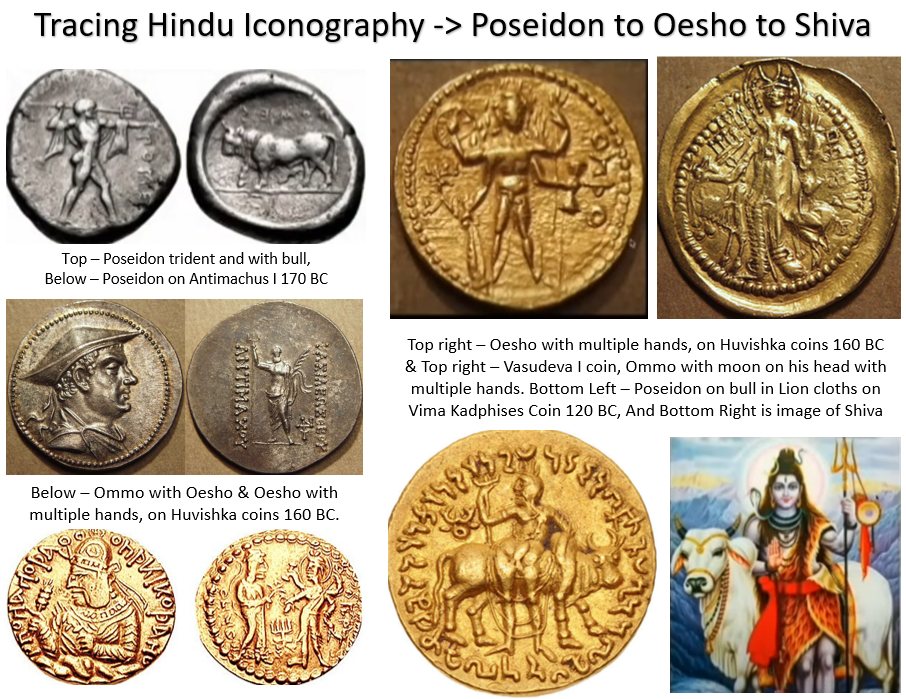
The concept of gods with multiple hands was a distinctive innovation, allowing deities known by different names in various regions to be visually combined into a single form, such as Lakshmi evolving from the Greco-Bactrian Tyche/Ardoksho, or Shiva drawing elements from Poseidon. This blending is especially evident in Gandhāran art, where Buddhist iconography also absorbed and reinterpreted Hellenistic motifs.
Astrology from Babylon and Greek
Human vocabulary is inherently limited, often reusing the same concepts across different contexts. Yet, the core meaning of a word typically remains tied to its original physical or spatial reference. Words evolve slowly over time, and this change occurs differently depending on context. In the oral sphere, everyday basic words like “mother” or “father”, which circulate freely and gradually shift in meaning. In contrast, written language, often transmitted through authority, tends to preserve technical terms, such as the names of kings, festivals, or places. This written continuity extends the lifespan of words and slows the natural diffusion of language into divergent, colloquial forms.
Indian astrology, as we know it today, is not an isolated creation but a synthesis shaped by centuries of cross-cultural exchange. Many of its foundational concepts like zodiac signs, planetary divisions, and aspects of predictive techniques show clear parallels with Babylonian, Greek, and Roman astrological traditions. The Babylonians developed early frameworks for lunar and solar calendars, along with the twelve-sign zodiac, which were later adopted and refined by Hellenistic astronomers. These influences reached India through trade routes and scholarly networks, culminating in the works of masters like Varāhamihira (6th century CE) who was a Maga Brahmana (descendent of Magi).
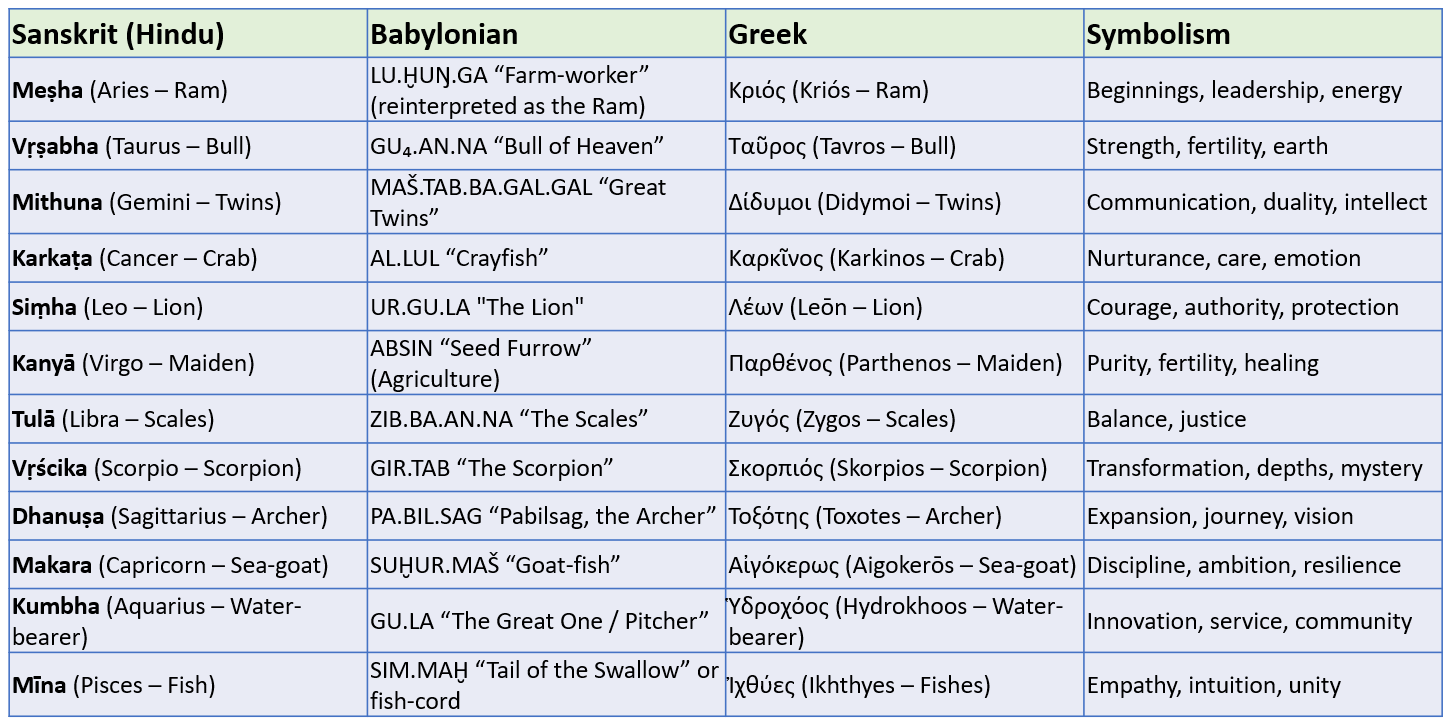
In his Bṛhat Saṁhitā and Pañca-Siddhāntikā, Varāhamihira explicitly referenced Greek (Yavana) methods of planetary calculation, the use of the seven-day week tied to planetary lords, and the division of the ecliptic into twelve 30-degree signs’ features with roots in Babylonian astronomy and Hellenistic science. He also preserved star names and seasonal markers traceable to Mesopotamian sources. This convergence illustrates not only the adaptability of Indian scholarship but also the global circulation of scientific and cosmological knowledge in the ancient world.
Saka-Parthian hegemony in Indian subcontinent
Archaeological and epigraphic evidence indicates that the Parthians often associated with the Saka peoples, held sway over vast regions of the Indian subcontinent for extended periods, founding ruling houses such as the Paratha kings in Baluchistan and western India. Among them, the Pahlavas, a Parthian branch who established kingdoms in northwestern India in the first century B.C., left a particularly enduring legacy. Historical records also note the influence of related dynasties, including the Sātavāhanas, the Western and Northern Satraps. Significantly, the earliest Sanskrit inscriptions in India date from the reigns of these kingdoms.
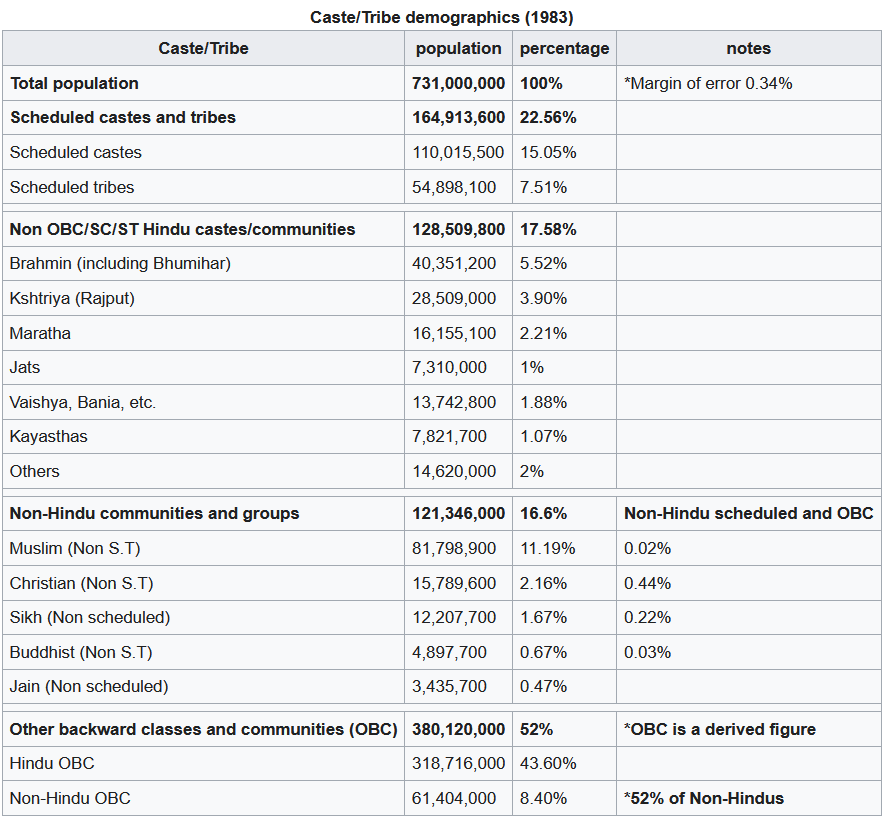
The capital of Satavahana was known as Pratishthana similar to Saka tradition of calling their land as Sakastan in Mathura’s Lion Capital. Pallavas of South India are also of Parthian decent. The enduring use of the Saka calendar serves as a tangible reminder of their cultural influence. According to the Mangal Commission, the Aryans constitute about 17% of the total Indian populations. This details in consistent with the ASI-ANI admixture studies that show roughly a fifty-generation gap between the major Dravidian and Aryan migrations.
These accounts strongly suggest that the “Aryan” influence in the Indian subcontinent coincided with the arrival of the Sakas. The Saka satraps established political and cultural footholds in various regions, influencing local traditions. Interestingly, the epithet “Sakya Muni” for the Buddha reflects this connection, as it literally identifies him with the Saka lineage or tribe. This indicates that the intersections of tribal, foreign, and local traditions were shaping religious and cultural narratives from this time onwards.
Tribal Knowledge and Aryanised Stories
The people and regions described in the Indian epics offer clues about the period in which they were composed. Many of these references correspond to regions and cultural markers from around the 2nd century BC and later. Unlike the Vedas, the Ramayana and Mahabharata reflect strong tribal traditions. These epics were not originally “Aryan” stories, but rather narratives rooted in Dravidian or Adivasi ASI admixture like Bhil, Gond tribal cultures. Variations of the Ramayana also appear in Buddhist and Jain traditions. The mention of Cinabhumi or Cina in Sanskrit within these epics indicates they could only have been composed after the Qin dynasty’s establishment in 221 BCE, from which the name is derived.
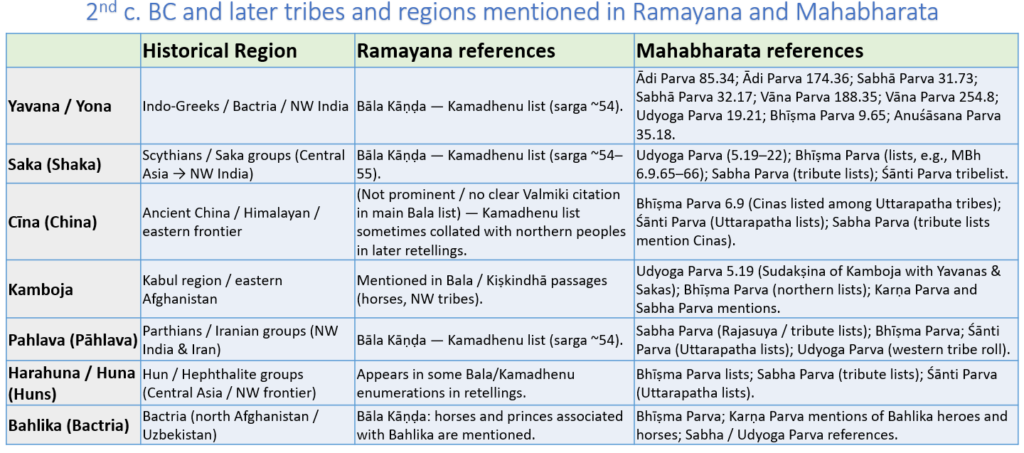
Similarly, in the Valmiki Rāmāyaṇa (Ayodhyā Kāṇḍa 109:33–34), Rāma refers to Budha as an atheist which is another marker inconsistent with claims of extreme antiquity. Any archaeological evidence linking these tales to any fixed historical period is still lacking credible proof. These texts contain other anachronistic references, such as the circulation of gold coins, the use of silk, the horses trading etc. In essence, these epics are narrative traditions rather than documented history. Neo-Hinduism can be seen as a synthesis of Vedic/Puranic and Śramaṇa traditions, shaped by the substantial influence of both.
No evidence of Vedic Period in India
The Vedic era is traditionally dated between 1500 BCE and 800 BCE, but there is no direct archaeological evidence to support this chronology. Chalcolithic cultures in India do not display images of gods, suggesting that much of what is claimed about early Vedic religion relies heavily on religious and political narratives rather than material proof. Even today, many older temples in India preserve Buddhist or Jain images that have been reidentified as Hindu deities, reflecting the historical dominance of Jainism and Buddhism before Brahminical influence became prominent. Despite suggestive archaeological features such as fire altars, ritual sites, and geographic overlaps, the Vedic Age still lacks direct, inscriptional, and stratified archaeological evidence that meets the rigorous standards applied in fields like biblical archaeology.
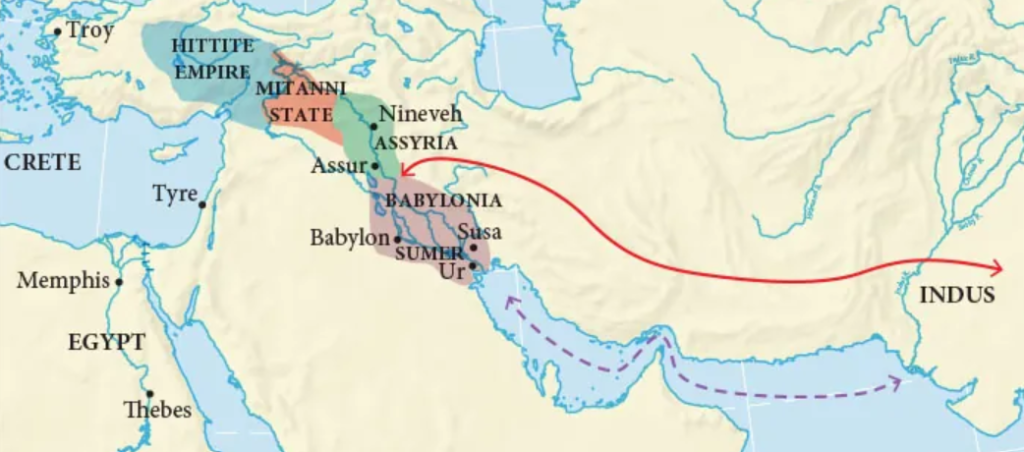
We can notice that Vedic religion shaped through its Medo-Parthian connections, gradually evolved into Brahminism after the 4th century CE, which emerged as a state-supported tradition seeking to integrate Buddhist, Jain, and Greek cultural elements into its theological framework. The Gupta period witnessed the rise of classical Sanskrit and a flourishing of Brahminical literature, which promoted the blending of Brahminical and Buddhist ideas with Greek iconography. By the 8th century AD, this synthesis had given rise to Vedantic Hinduism alongside the bhakti tradition, as local communities increasingly adopted and adapted these practices. This transformation also facilitated the assimilation of diverse castes into devotional movements.
Scientific Delusion and Eastern Philosophy
In the modern era, Gandhian philosophy played a central role in shaping neo-Hindu thought, weaving together historical layers of Vedic, Buddhist, and later influences into a contemporary framework. It is noteworthy that most surviving Sanskrit works date only from the 7th century CE onwards, reflecting a relatively late literary consolidation. Several Christian historians have argued that both Vedic and Buddhist traditions contributed key concepts that paralleled the rise of evolutionary ideas.
“What can the righteous do when the foundations are destroyed? (Psalms 11:3)” This question underscores the challenge of discerning truth in an age dominated by shifting ideologies. The evolutionary mindset, with its emphasis on hypothetical reconstructions, often becomes a hindrance to the pursuit of absolute truth. In the modern era, Gandhian philosophy acts like a “video game bug” destroying the foundations of ethics.
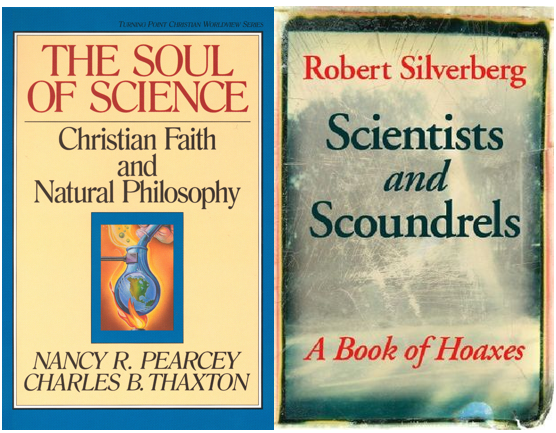
In the 20th century, secular psychologists such as Carl Jung and Sigmund Freud also drew upon these worldviews, often emphasizing relative truths over absolutes. The stagnation of progress in Physics is directly proportional to the overreaction to eastern philosophy. The rise of multiverse theory, string theory are all result of losing site of creation and its creator. They are tiring to find the ‘god partial’ without acknowledging the God of Creation and thinking themselves to be wise are become fools by dabbling into the occult.
When speculative thought experiments are detached from reality but yet are elevated to the level of science or religion, they can easily be co-opted by ruling elites for power, prestige, or patronage. Such patterns of manipulation have persisted across cultures and throughout history. That’s why evolutionary mindset is a major hindrance to know the truth. The Bible condemns this narrow outlook of Eastern philosophies in Isaiah 6:2 highlighting the vision derived from it by emphasizing the need to anchor human understanding in truth rather than in shifting human constructs.
Check the Related Topics
- Dravidian Culture: Colonization of India by Elam, Akkad and Ur III
- Behistun Inscription, Elamite Scribes and creation of Brahmi Script
- Indian (P/Bharath), Aryanised Saka’s and the Kings of the East
- Undercurrents of History: Mitra, Tara, Abbanes and others Icons
- True Prophets, Heathen believers and the rise of Monotheism
- Knowing Indian History is the key to unlock Book of Revelation
- Four Wind’s, Harvest and Regathering of Israel (Rom 11 & Rev 7)